Description
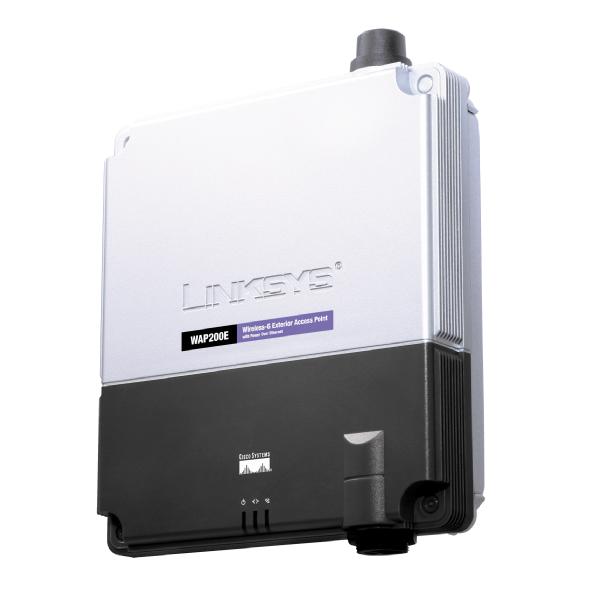
The Cisco? WAP200E Wireless-G Exterior Access Point (Figure 1) lets you connect Wireless-G (802.11g) or Wireless-B (802.11b) devices to your wired network, so you can add PCs to the network without the need for additional cabling. This weather-resistant access point creates a “wireless bubble” in exterior spaces, such as patios and outdoor caf?s. Power over Ethernet (PoE) support makes it easy to install, and you can create multiple basic service set identifiers (BSSIDs) that connect to individual VLANs to keep your traffic separated.
The Cisco WAP200E is also ideal for use as a bridge to connect remote areas. For example, it could be used to connect offices with a warehouse housed in a separate building, or to connect the buildings of a college campus. Installing one access point on each building provides connections at up to Wireless-G speeds – with no cable to run. The weather-resistant housing protects the access point and is lightning protected.
To protect your data and privacy, the Cisco WAP200E supports both Wired Equivalent Privacy (WEP) and the industrial-strength wireless security of Wi-Fi Protected Access (WPA), encoding all of your wireless transmissions with powerful encryption.
Manufactured by: LINKSYS
Model/Part : WAP200E
Device Type: Wireless Access Point
Standards: IEEE 802.11g, IEEE 802.11b, IEEE 802.3, IEEE 802.3u, IEEE 802.3af (PoE), 802.1p (QoS priority), 802.1Q (VLAN), 802.1X (security authentication), 802.11i ready (security WPA2), 802.11e ready (WMM and unsolicited automatic power save delivery [U-APSD]), 802.11F (wireless roaming)
Ports: 1 Ethernet, 1 external antenna
Buttons: Reset
Cabling type: Unshielded twisted pair (UTP) Category 5
LEDs: Power, Ethernet, Wireless
Web user interface: Built-in web user interface for easy browser-based configuration (HTTP/HTTPS)
Static IP: Yes
Dynamic Host Configuration Protocol (DHCP) client: Yes
SNMP versions: 1, 2, and 2c
Access point: Access point mode, point-to-point bridge mode, point-to-multipoint bridge mode, repeater mode
Spec/modulation: 802.11b/direct sequence spread spectrum (DSSS), 802.11g/orthogonal frequency division multiplexing (ODFM)
Data rates: 802.11b: 1, 2, 5.5, 11 Mbps; 802.11g: 6, 9, 11, 12, 18, 24, 36, 48, 54 Mbps
Channels: 11 North America, 13 Europe (ETSI and Japan) auto-channel selection
Number of internal antennas: 2 at 6 dBi (directional)
Antenna connector type: Reverse polarity female N-type
RF power (Effective Isotropic Radiated Power [EIRP]): 802.11g: typical 16.5 dBm, 802.11b: typical 17 dBm
Antenna gain: Internal antenna: 6 dBi
Adjustable power: Yes
Receiver sensitivity: 802.11g: 54 Mbps at -65 dBm, 802.11b: 11 Mbps at -85 dBM
WEP/WPA/WPA2: WEP, WPA-PSK, WPA2-PSK, WPA Enterprise, WPA2 Enterprise
Connection control: Wireless connection control: MAC based
SSID broadcast: SSID broadcast enable/disable
802.1X: IEEE 802.1X support
Wireless client isolation: Wireless client devices can be isolated from each other either within an SSID or between 2 SSIDs; both isolation modes can be enabled at the same time.
Web-based utility access control: HTTP/HTTPS, wireless client web GUI access control
Dimensions: 6.42 x 8.07 x 2.17 in.
Unit weight: 2.47 lb (1.121 kg)

Reviews
There are no reviews yet.